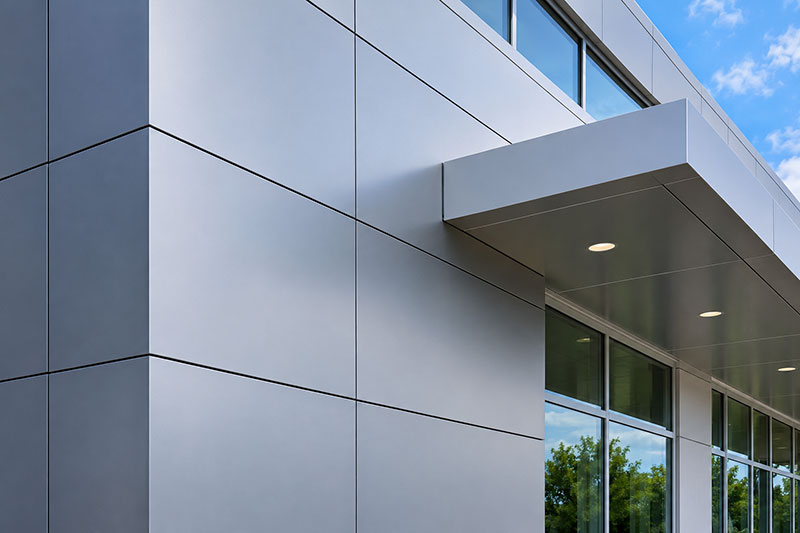
Vogler Sheet Metal provides metal plate wall systems for architects, developers, general contractors, institutional facilities, healthcare campuses, and commercial projects throughout Houston, the Gulf Coast, Texas, Louisiana, and surrounding markets. Metal plate is cladding cut from solid aluminum, formed into panels, and hung on concealed clips. There is no core and no laminate, which gives the wall a crisp, flat face and a surface that holds up to impact.
Architects specify metal plate where appearance and durability both matter, and where fire performance drives the wall assembly. Solid aluminum is non-combustible and works with many NFPA 285-tested assemblies, so plate is a common choice for schools, hospitals, civic buildings, and other projects with strict code requirements.
Vogler fabricates panels in-house and self-performs the installation, so one team is accountable from shop drawings through the last panel.
What Is a Metal Plate Wall System?
A metal plate wall system is cladding made from single sheets of solid metal, usually aluminum. Each sheet is formed into a panel, finished at the factory, and attached to the wall with concealed clips, leaving the face free of visible fasteners.
Plate systems are commonly specified when architects want:
- A flat, monolithic appearance
- Non-combustible cladding
- A tough, dent-resistant surface
- Crisp shadow lines and reveals
- Custom colors and finishes
- Long-term durability
Metal Plate or MCM?
Both create a flat, high-end façade. They are built differently, and the difference matters on some projects. Our Commercial Metal Composite Material (MCM) Wall Panels page covers the other option.
| Feature | Metal Plate | MCM |
|---|---|---|
| Construction | One piece of solid aluminum | Two thin metal skins bonded to a core |
| Fire | Non-combustible, works with many NFPA 285-tested assemblies | Depends on the core; fire-rated cores available |
| Dents and Impact | Tougher surface | Thin skins can dent |
| Weight | Heavier | Lighter |
| Flatness | Set by plate thickness, depth, and stiffeners | Naturally flat |
| Best For | Schools, healthcare, entries, ground-level walls | Large flat fields, weight-sensitive structures |
Our team can help you decide which fits your project.
Benefits of Metal Plate Wall Systems
Advantages include:
- Solid aluminum with no core to delaminate
- Non-combustible construction
- Tough, dent-resistant surface
- Clean, flat architectural appearance
- Concealed clip attachment
- Dry joints with no caulk to fail
- Custom colors and finishes
- Aluminum, zinc, stainless, and anodized options
- Perforation options for screens and graphics
- Compatibility with modern building envelope systems
- Excellent performance in Gulf Coast environments
- Low maintenance requirements
Our Metal Plate Wall System Services
Vogler Sheet Metal provides complete metal plate wall solutions from design coordination through final installation.
Services include:
- Shop drawings and panel layouts
- In-house panel fabrication
- Metal plate wall panel installation
- Clip-hung dry-joint plate systems
- Rainscreen plate systems
- Custom flashing fabrication
- Sheet metal trim fabrication
- Window and door transition detailing
- Expansion joint detailing
- Waterproofing integration
- Drainage detailing
- Soffits, column covers, and feature walls
- Renovation and recladding projects
- Repair and replacement services
Systems We Install
Clip-hung dry-joint plate. Panels are formed from solid plate and hung on staggered angle clips, then set and adjusted one at a time. Joints are dry, so there is no sealant to chalk, stain, or fail. Aluminum is used, with zinc, stainless, and anodized options on request.
Rainscreen plate. The same plate with open reveals. Perimeter extrusions float in a track so the wall can move with temperature, and air moving behind the panel lets the cavity drain and dry. It works over wood or metal substrate.
Applications for Metal Plate Wall Systems
Metal plate systems are commonly used on:
- Commercial buildings: corporate offices, retail developments, mixed-use projects, hospitality
- Institutional facilities: universities, K-12 schools, churches, municipal buildings
- Healthcare facilities: hospitals, medical offices, healthcare campuses
- Civic and government: fire stations, courthouses, government offices, public facilities
- Aviation and transportation: airport facilities, transit stations, transportation terminals
Design Flexibility for Architects
Metal plate gives architects a precise, flat surface that still carries a lot of design. Panels can be installed horizontally, vertically, or in mixed orientations, and options include:
- Flat and reveal appearances
- Custom colors
- Metallic and anodized finishes
- Perforated patterns, including logos and lettering
- Mixed panel sizes and depths
- Flat or tapered panels
- Custom shapes and details
Building Envelope Performance Matters
A successful wall panel system depends on much more than the visible panels. Water management, flashing details, drainage pathways, expansion joints, penetrations, and transitions all play critical roles in long-term performance.
Houston and the Gulf Coast add heat, humidity, heavy rain, wind events, and UV exposure. A dry-joint plate system has no sealant to fail, and a rainscreen version lets the wall drain and dry. Vogler helps match plate thickness, depth, and clip spacing to the wind load.
Vogler Sheet Metal brings expertise in:
- Architectural wall systems
- Commercial roofing
- Waterproofing
- Custom sheet metal
- Flashing fabrication
- Drainage integration
This building envelope knowledge helps ensure the entire assembly works as intended.
Why Architects and General Contractors Choose Vogler
Successful projects need a contractor who understands both design intent and construction realities. Vogler has worked in sheet metal in Houston since 1904, and today combines in-house fabrication with experienced installation crews and self-performed field work.
Architects and contractors choose Vogler Sheet Metal because we understand:
- Architectural detailing
- Building envelope integration
- Project coordination
- Schedule requirements
- Quality control
- Long-term performance expectations
